No Regrets

Recently, I was having a conversation with a friend of mine about the difficulties people have opening up and letting others in, in the context of saying what’s on your mind, making your feelings known…expressing yourself.  It’s a conversation that I seem to be having a lot lately, and it got me thinking about how we often let our fears and insecurities dictate our lives.  In what felt like a scene out of a movie, John Mayer’s “Say” started playing in the background as we were talking.

Say what you need to say

Say what you need to say

Say what you need to say

Say what you need to say

In my tight-knit circle, it is known that I have no problem saying exactly how I’m feeling about a situation.  It’s a trait that is often admired, although I don’t know if it deserves the praise.  It sort of goes hand-in-hand with my penchant for the truth.  Ever since I was sixteen, honesty has been extremely important to me.  As such, I have vowed to always be honest with the people that I care about, no matter what.  If I feel that I would regret not saying something – no matter how hard that something might be – I say it, because there are so few things in life that we can actually control, and I don’t want to live my life thinking what if I had done this…because I know myself, and that’s exactly what I would do.

It’s not about being stronger versus weaker, and I think a lot of people don’t realize that.  They think that they are weak because they have a hard time sharing their feelings and feel that people like me are fearless.  But they’re wrong.  I’m just as scared, only I choose to live through the fear as opposed to living in it.  More often than not, I’m terrified to share my innermost thoughts, to give someone else the power to break me, but I don’t allow that fear to get in the way of something that I know needs to be said.  You can live in fear every day, but that will only do more harm than good, and it certainly won’t help you to move on or grow.

Have no fear for giving in

Have no fear for giving over

You’d better know that in the end

It’s better to say too much

Then never say what you need to say again
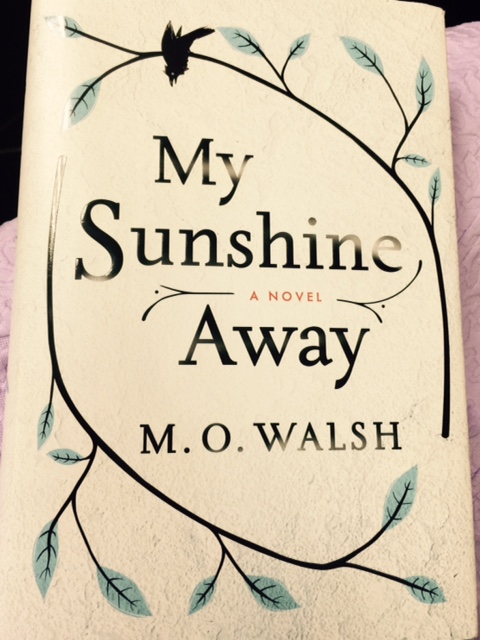
M. O. Walsh’s My Sunshine Away

There has been a trend as of late. I’m not sure if it is an actual trend per say, or if it is more the books that I am picking – although I’m inclined to believe the former, seeing as how I make a conscious effort to not read anything similar in a row. There seems to be a fascination with darkness, with subjects that are disturbing, devastating, unthinkable. Things that have the power to – and do – forever alter a person’s life. These books that I’m describing reach far beyond the shallowness of the shoreline that Nabokov introduced us to with Lolita, which, although unnerving, was quite tame considering the subject matter. They exceed the vast expanse of the sea…their depth sometimes immeasurable…their affects profoundly lasting.

My Sunshine Away is one of those such novels. And I suspect that it will haunt me for a long time. The title alone left me with an eerie feeling – part of a verse from a song I knew in my youth:

You are my sunshine, my only sunshine

You make me happy when skies are grey

You never know, dear, how much I love you

Please don’t take my sunshine away

but it also was the reason that I read it. The heaviness that I felt from those words intrigued me much more than other three-word combinations have. They felt empty, but not because something was lacking, empty because there was something that no longer existed, something that had been taken away. Something that had died.

The story centers on a crime that was committed a few decades in the past. The unsolved rape of a fifteen year old girl and the implications that it had not only on her life, but on the lives of her community, her neighborhood, her family, her friends. There were four suspects in this, including our narrator who remains nameless throughout. From the first page I was on the edge of my seat closely examining the narrator’s words, looking to find holes in his story, trying to decide if he was the one who committed the crime. I won’t say whether or not we end up with an answer to this question because the who or why is not significant. The significance is in what was lost. Innocence.

Innocence, once lost, can never be recovered, especially when that loss happens in such a heinous way. It happens often in literature, as in life, but it’s portrayal here is not something that erases itself from your memory after you’ve turned the last page. It’s something that sticks with you. Just like that song. Please don’t take my sunshine away.

My Sunshine Away