The Devil in Silver

About a month ago, I finished reading a book entitled, The Devil in Silver, written by Victor LaValle.  It was one of my Christmas presents from my amazing boyfriend, who picked it out from a list of top books of 2012 (in the top five), despite not being sure if I would love it or not.  The story sounded interesting enough, but I wasn’t completely sure either.  Lucky for me, I had just finished a book a few weeks before and was scant of anything that sounded interesting (don’t get me wrong, I have quite a few books at home that remain to be read, but sometimes you need something that is completely different and therefore refreshing).  I have been on one of those hard-to-get-into-anything book moods for a while now (don’t you hate those?) and picked it up right almost right away.  I was hooked immediately. 

The novel takes place inside a fictional mental hospital in Queens, NY, where the main character, Pepper, is taken by police after he is arrested for something that he can’t even remember.  At first he is hesitant and throughout much of the book tries to convince everyone that he doesn’t belong there (but does he?), then he comes in contact with a deformed, monsterish patient one night.  In time, he befriends a few patients in hopes to vanquish this monster…”the devil.”

One thing about this book I would like to say.  Many times I have argued that I prefer reading books that are exceptionally written with a less interesting story; I have actually read books where I didn’t care about the characters at all, but they were just so beautifully written that I couldn’t help myself…I had to keep reading to the end.  I’ve had this argument with my boyfriend (and others), and although they agree that it is nice to have an exceptionally well written piece, they would sacrifice the writing for a more interesting story.  Case and point, The Game of Thrones.  I started reading it because I had made my boyfriend read Tana French’s In the Woods (mine was the case of an exceptionally written novel and a great story, as are all Tana French novels), but only got through the first three hundred pages.  I found the writing to be good (not great), and the story, although interesting, way too clunky.  Similarly, in The Devil in Silver, LaValle’s story is interesting enough to grab my attention, but I feel that his writing is a bit mediocre, and it seemed more like he was telling the story in his own speaking voice rather than in his writing voice.  That didn’t stop me from liking the book, just made me think about how I could make it better. 

The moral of the story: I guess I can read and like books that are not exceptionally written…but I prefer the ones that are.

The Dud Avocado

I have not read a book in the past four months, ever since I had become obsessed with the last one, and wanted more and only more of that…until now.  Last Friday, as I was sitting in the doctor’s office with the April edition of Vogue (I was the only one who came prepared), I stumbled across an article that mentioned the author Elaine Dundy.  Her debut novel, The Dud Avocado, which was first published in 1958 and then out of publication in the United States until 2007 when it was reprinted, was discussed as being bubbly and comedic.  The title itself stuck out to me.  Who would think of naming their novel that?  Is it quirkily referencing something that I should know?  I immediately set about googling it and reading some of the reviews; one of which made a comparison of it to Sex and the City: I was sold.  I had to have it.  I signed onto Amazon and, to my satisfaction, there were only two or three copies left.  I purchased one of the remaining copies and received it in the mail Tuesday after I got home from work.

The novel is set in 1950s Paris where, the main character Sally Jay Gorce, an American, is spending two years after graduating college.  When we first are introduced to Sally Jay, she is traversing the streets of Paris wearing a ballgown in the middle of the afternoon because she had run out of clean laundry and was having “issues” getting to the cleaners.  Apparently, they would close for a few hours in the middle of the day and that seems to be the only free time she has.  I find the idea of anyone walking around the streets in a ballgown during the day hilarious because I would never think to do it…although, living in NYC, one could probably get away with it with the smallest amount of stares: people wear a lot of really odd outfits in Manhattan at any time of day. 

I have only just started this novel, but I think that it may become one of my favorites.  There is something about it that gets to you right away…maybe it just feels real, almost like you could actually live it as opposed to other novels where, for one reason or another, that is clearly not the case.  It only boasts 255 pages which, for many of you may seem like a good thing because it’s not too long but, for me, it’s sad because I already know that I am going to speed through it and finish it way too quickly :(.

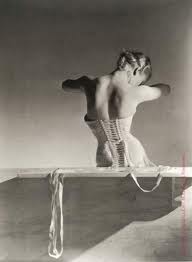
Mainbocher Corset – Horst P. Horst

In the 1939 September issue of Vogue, Horst P. Horst’s photograph “The Mainbocher Corset” was first shown to the world. As described by the photographer himself, it was the last shot of the day taken in his Parisian studio in August of that year. While the image may have been last minute, its impact has been anything but (and it is not just me who thinks so; if you Google this image, there’s a lot to read about it). It is by far one of Horst P. Horst’s most famous photographs, as well as one of the most iconic of this past century. It possesses a beauty that is both erotic and timeless.

The first time I set eyes on this photograph was over a year ago. I had been flipping through Glamour (I think) and I came across an advertisement for the Condé Nast store. It really was love at first sight. I immediately went onto their website and searched through what felt like hundreds of photographs until I found the one that I coveted. The smallest print, which is fairly large in size, goes for $125 before tax (but I want the next size up which costs $149 before tax). Oh, and I emailed it to everyone I know asking if they too were in love with it…I was a little obnoxious about it.

This photograph, though quite simple, draws the eye in right away. First you notice the positioning of the head and arms. The woman’s arms are jutting out on both sides of her, sort of cradling her head as she looks down. This positioning also shows off her neck, which in turn elongates her back. The corset has clearly been loosened; there is evidence of this in the way that you see a slight gap between it and her body on the left side as well as the lacing that is strewn about on the bench behind her, as if she is discarding a piece of herself. This is also displayed in her back itself, which is not rigidly straight. One would expect a corset to constrict movement, not fulidify it. The room that which she’s in is barren, but she seems relieved, almost content; it makes the observer wonder what she is thinking about at that moment. Does she know how beautiful she is? And then there is of course the lines of her back themselves. The fact that they’re asymmetrical makes her back interesting. The positioning of her arms lends to a muscular tone to her back, which suggests strength. Despite the fact that this woman is turned away she possesses this strength that you cannot turn away from.

Although I do not yet own this photograph, one day I will. I am still in love with the beauty and strength of it all. I can still just sit and stare at it (on the website) dreamily. I want to be that woman in the photograph, to loosen my corset and thereby loosen my thoughts on life and just live in the moment, embracing myself and my new-found state of mind. The beauty is timeless because it transcends generations. Corsets aren’t worn anymore, aside from lingerie in the bedroom, but the loosening of the corset still speaks volumes over seventy years later. It is by far one of my favorite photographs of all times.

Moment of Peace

I wouldn’t consider myself an expert on music, but I can pick out the good from the bad and I do know what I like, which is more than most can say. Like many of us, during junior high and into high school, I took part in drama club and although I didn’t have any lead roles, I sang proudly (and on key) with the chorus.

One of my oldest friends whom I met during my high school years, went to school one town over in Cold Spring Harbor. We spent many a weekend together and had what seemed like endless late night phone conversations. It didn’t take long for me to consider Ben one of my close friends.

As long as I have known Ben, he’s been part of a band. As the years have gone by we’ve kept in touch sporadically, but I have always followed his music. Which ever band that he’s been in, I have loved and it has definitely not been because we grew up together. His music is just so unique but at the same time, possesses an old school rock quality (to quote a friend, whom I made listen to his music:)) that must be heard.

New Beard, the band that Ben is currently a part of is no different. Last week, I was excited to find out that they had come out with their debut, an EP entitled Moment of Peace, which, I downloaded from amazon right away; one of the songs is also entitled the same, and it is definitely my favorite. All of the songs have a unique sound but seem to share the old school rock feeling that I have come to love. Every time I hear Ben’s voice singing, I get chills and I stop what I’m doing and concentrate on the music and lyrics.

New Beard’s fantastic and if you have yet to hear their stuff, I suggest you do so now. You will fall in love with them as I have. If you’re lucky, you’ll get to see them live. As soon as they play somewhere other than Brooklyn (I hate Brooklyn) I will be seeing them as well.

Kazuo Ishiguro’s The Unconsoled

In Kazuro Ishiguro’s The Unconsoled, passageways are ever present. The main character, Ryder, is constantly being led through long, elaborate passageways, no matter where he goes. Even the simplest, most closest place requires much travel. What’s interesting is that most of these elaborate passageways seem to lead Ryder to different parts of the same place. And, with each “road” that he travels, another and another one comes about, almost as if they were planned as such, though they seem to be a matter of mere coincidence.

With that also comes memories, slivers into Ryder’s past and present. Ishiguro uses the physical passageways that Ryder travels through as mental ones that stream through his mind. In fact, one can even pose the idea that the hotel where Ryder is staying at, and therefore the center of all his journeys, could be a physical representation of Ryder’s brain, and all the passageways that he embarks through, the signals that his brain is sending out in order to try to mend what is clearly a disconnect. At first, the memories that Ryder obtains are sporadic and shallow, but as the novel progresses these memories come at a more frequent pace and are much deeper in caliber.

Ishiguro is a master storyteller, and although many have expressed the opinion that this novel is not one of his best, I disagree. The Unconsoled should be considered a brilliant work of fiction. Ishiguro weaves us around and around in the same circle, except that with each familiar turn we learn something new and unexpected. We come to expect the unexpected, although the transpiration is never predictable. Some of the paragraphs are dauntingly long, spanning for pages at a time, but that sort of adds to the character of it.

The point of reading this novel is not necessarily for the end result, but rather the experience of it and that’s what those who find this novel a disappointment do not seem to understand. It teaches you a new way to read and enjoy, and at the same time leaves you with a satisfaction that is insurmountable.

My Love for the Detective Novel

I never thought that I would be one to love reading detective novels. Sherlock Holmes comes to mind, the author James Patterson, to name a few. They always follow the same formula. There’s a good guy and a bad guy (though, sometimes the who-is-who, is not always established from the beginning) and there is a crime that was committed that needs to be solved. I am also not a fan of the main-stream novels, you know the ones that everyone reads by those authors that just seem to be able to crank out an innumerable amount of stories. When I was younger I was envious towards them. I couldn’t understand how they were able to write so much when I had trouble finishing most of the things that I started. As I read more and more of these novels though, I came to realize that I didn’t envy them after all. Their bodies of work were plentiful, but they were mediocre at best. They were all practically the same with slight variations. If you’ve read a few books by any of these authors, you’ve read them all. I realized then that I didn’t want to be one of those writers; I’d rather spend half my life cranking out one great story than to mindlessly author many.

That was when I became a book snob. Aside from reading Dan Brown’s The Da Vinci Code, which was widely popular in its day and truly brilliant, I set out to read novels that weren’t so well known or read. I can pretty much guarantee that if you were to name all of the books on the most popular list of the moment, I have maybe read one. Not to say that they are terrible and should not be read, I just feel that there are more that are far better that are hardly known.

When I was in college, out of all of the English classes that I took, there were only two that I loved. They were both very different in their content and approaches to learning, but they both gave me something that, had I never taken them, I might never have discovered that I loved. The first was a class on Victorian literature. There, I learned that that was my favorite time period of literature. I loved reading the long descriptive paragraphs about life back then; just the way that the words were used; I cannot to this day find anything as appealing to me. The second one, entitled simply Dreams, I loved far more. The literature in that class wasn’t focused on a specific time period, but rather pairing great works of fiction with dream theorists and of course Freud was there. Instantly I fell in love with Freud. I didn’t necessarily agree with most of what he wrote, but it was the way he wrote them. The novel that I am currently reading, Kazuo Ishiguro’s The Unconsoled, is a leftover from that class that has been sitting on my bookshelf for a few years. It’s a psychological mystery, which I will go into at length when I have finished it.

It was in that Victorian literature class that I came upon the first detective novel ever written, The Moonstone by Wilkie Collins. It is told through multiple narrators, where the reader learns little bits and pieces until finally the conclusion comes. Who knew that with one great work of fiction, a whole genre would be spawned. Although most people may not have heard of him, we all have Collins to thank for this.

Another thing to know about my book snobbiness is that I am not a fan of American literature. There are a few pieces that I do love, for example F Scott Fitzgerald’s The Great Gatsby and Arthur Miller’s The Crucible, most of American literature I find boring.

A few years back, a friend of mine at work handed me Tana French’s debut novel, In the Woods. He loved books just as much as I did and with the exception of a few that I couldn’t focus on enough to sit through, he hadn’t steered me wrong. In the Woods is of course a psychological mystery (aka a modern phrase for the detective novel, a sub-genre if you will). It starts off with a group of kids that went into the woods surrounding their community one night and only one of the three made it back. The other two disappeared, never to be seen again. Jump forward decades into the present and that one kid works on the murder squad and there is a murder in those very same woods. French is brilliant at creating this energy that really grips the reader insofar as to clench at your core. When the main characters were overcome with sadness, I cried…when they were scared out of their wits, I screamed. Needless to say that when I found out that Tana French had come out with a second novel, I flew to the bookstore and purchased it immediately; the same went for when she came out with her third.

I have never had a story effect me so much as I did with Ms. French’s. I would literally come home from work and plop myself on the couch, staying up way past the time that I should have, just to read her words. I would wake up in the middle of the night screaming, my heart pounding rapidly in my chest and my body in a cold sweat, turning all of the lights on in my apartment because my mind had continued to subconsciously circulate the passages that I had just read. The same thing would happen the next night and the next until I had finished each novel. I laughed at myself for having such a strong reaction.

The other two of Tana French’s novels are entitled The Likeness and Faithful Place. These, along with In the Woods, are brilliant works of fiction that should be read. I am anxiously awaiting her fourth novel, which has yet to surface. Did I mention the French is an Irish author?